Greece walking tours
Greece is the birthplace of Western civilization and a land of thousands of islands. Walk beneath the Acropolis in Athens, follow the white lanes of Santorini and Mykonos, explore the Venetian harbors of Crete, the medieval walls of Rhodes and the monasteries of Meteora, and stop at a seaside taverna for grilled fish, olive oil and a glass of local wine.
- cities
- 20
- 4K videos
- 135
- of walking
- 115 h
- regions
- 9
- Capital:
- Athens
- Language:
- Greek
- Currency:
- Euro (EUR)
Did you know?
- From our data15M viewsMykonos is the most-watched walking city in Greece: the top 4K walking videos of it on YouTube add up to 15M views.
- From our data4 hoursOur longest walk in Greece was filmed in Rhodes: "Rhodes, Greece: Greek Summer Walking Tour".
- From our data12 night walks12 of our videos in Greece were filmed after dark.
- From our data6° of latitudeOur cities in Greece run from Kavala in the north to Heraklion in the south.
Most-watched walking cities in Greece
Ranked by total YouTube views of 4K walking videos. See the full study
 ▶ 7A walk throughMykonosWindmills, Little Venice and whitewashed lanes.7 videosExplore →#1
 ▶ 8A walk throughAthensThe Acropolis above, lively Plaka streets below.8 videosExplore →#2
 ▶ 7A walk throughCorfuVenetian streets, two fortresses and a green island.7 videosExplore →#3
 ▶ 8A walk throughRhodesA medieval walled town of knights and stone lanes.8 videosExplore →#4
 ▶ 7A walk throughChaniaA Venetian harbor and lighthouse on the island of Crete.7 videosExplore →#5
 ▶ 7A walk throughThessalonikiA seafront promenade, Byzantine churches and great food.7 videosExplore →#6
All cities in Greece
South Aegean · all 7 cities →
 ▶ 10A walk throughSantoriniWhite villages and blue domes on a volcanic cliff.10 videosExplore →▶ 7A walk throughMykonosWindmills, Little Venice and whitewashed lanes.7 videosExplore →▶ 8A walk throughRhodesA medieval walled town of knights and stone lanes.8 videosExplore →
 ▶ 6A walk throughParosA Cycladic island of whitewashed harbour towns, marble lanes and mountain villages.6 videosExplore →
 ▶ 6A walk throughNaxosThe largest of the Cyclades, with a marble gateway, a Venetian castle town and long sandy beaches.6 videosExplore →
 ▶ 6A walk throughKosThe island of Hippocrates, with a knights' castle, ancient ruins and palm-lined streets.6 videosExplore →
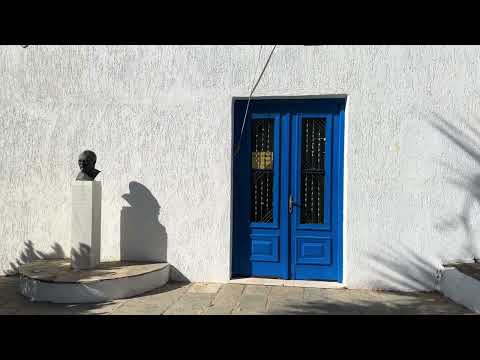 ▶ 6A walk throughMilosA volcanic Cycladic island of white rock coves, fishing villages and hilltop sunsets.6 videosExplore →
Crete · all 3 cities →
▶ 7A walk throughChaniaA Venetian harbor and lighthouse on the island of Crete.7 videosExplore → ▶ 7A walk throughHeraklionCrete's capital, gateway to the Palace of Knossos.7 videosExplore →
 ▶ 6A walk throughRethymnoA Cretan town of Venetian lanes, Ottoman minarets and a great seaside fortress.6 videosExplore →
Ionian Islands · all 4 cities →
▶ 7A walk throughCorfuVenetian streets, two fortresses and a green island.7 videosExplore → ▶ 6A walk throughZakynthosAn Ionian island of turquoise coves, sea turtles and a rebuilt Venetian-style harbour town.6 videosExplore →
 ▶ 6A walk throughKefaloniaThe largest Ionian island, with dramatic beaches, cave lakes and harbour villages.6 videosExplore →
 ▶ 6A walk throughLefkadaAn Ionian island joined to the mainland, famous for its bright blue water and white cliffs.6 videosExplore →
More regions


Right now in Greece
Local time, and a walk that matches the moment.
Ways to explore Greece
Where to stay
Exploring Greece on foot
Greece is a walking country in the most literal sense. Its towns grew up on hillsides and harbours long before cars, so the old centres are lanes, stairways and squares, and the ruins of the ancient world sit in the middle of modern cities. Athens has the Acropolis above its streets, Thessaloniki has a seafront promenade and a Byzantine upper town, and on the islands whitewashed villages climb from the water to windmills, churches and fortresses. Most visitors combine one or two mainland cities with a few islands, which is easy because ferries link many of them.
The best approach is to pick a base for each stop and walk everything inside it. Athens needs at least three days, Santorini and Mykonos each reward one or two, and the bigger islands such as Crete and the Ionian Islands are better explored with a bus, a hire car or a local tour for the outer villages. Our city pages show each place on video, and the Athens itinerary and Santorini itinerary turn them into day-by-day plans.
Where to walk
Athens is the place to start. The Acropolis and its Parthenon dominate the city, and the lanes of Plaka, the old quarter at its foot, are full of tavernas and small shops. Above Plaka, Anafiotika is a village of whitewashed cottages built by workers from the island of Anafi, with steep stairs that feel far from the city below. The Monastiraki flea market, busiest on Sunday mornings, and the Ancient Agora next to it make a good morning. Outside the centre, Cape Sounion, with the temple of Poseidon on its cliff, is a day trip by road along the coast, and the Athens Riviera has long beaches along the coast, reached by tram from the centre.
Thessaloniki, the second city, is a different kind of walk. Its waterfront promenade runs past the White Tower, an Ottoman-era landmark that now houses a museum, and the city's Byzantine churches and the Rotunda are a short walk inland. The upper town of Ano Poli climbs the hill behind the centre, and the covered Modiano market and the old warehouses of Ladadika are where locals eat. Thessaloniki is one of the best cities in Greece for food, and it is compact enough to walk end to end in a day.
On Crete, the Venetian harbours of Chania and Rethymno are the most rewarding walks, with old houses, lighthouse and fortress views and lanes of small workshops. Heraklion has Venetian walls and a lively market quarter, and the Minoan palace of Knossos lies just outside the city, a short bus or taxi ride away. In the south-east, Rhodes has one of the best medieval towns in Europe, a walled old city built by the Knights of St John, with its Street of the Knights and the Palace of the Grand Master.
The Ionian Islands are greener than the Aegean. Corfu has a UNESCO-listed Old Town of Venetian and later buildings around its arcaded square, Zakynthos has a lively waterfront and the Navagio shipwreck beach, which you reach by boat, and Kefalonia and Lefkada combine small harbours with cliff and cove beaches. In the north-west, Parga is a seaside town under a Venetian castle.
In the Cyclades, Santorini is famous for its caldera, the flooded crater of a volcano, with the walking path from Fira to Oia along its rim, about 10 kilometres. Mykonos is smaller and busier, and its town is a maze of white lanes around the old port, Little Venice and the windmills, while Paros has the whitewashed town of Naoussa and Naxos has a hilltop old town with the Portara, the marble gate of an unfinished temple. Milos is known for the fishing village of Klima, with its colourful houses over the water. Kos, close to the Turkish coast, has a town with a medieval castle and the Asklepion, the ancient healing sanctuary.
On the mainland, Nafplio was the first capital of modern Greece, and its old town is a pleasant grid of Venetian and neoclassical streets under the Palamidi fortress, with a small islet fortress just offshore. Meteora is a different landscape altogether: its monasteries stand on sandstone pillars above the town of Kalambaka, and it is a UNESCO site. Kavala, in the north-east, has a castle-topped old town and an old aqueduct, and the ancient city of Philippi is a short drive inland.
When to go
May, June, September and October are the best months for walking. Summer, from July to August, is hot, often above 35 degrees in Athens and on the islands, and the most crowded time in the Cyclades and Ionian Islands. Start walking early, rest through the middle of the day and go out again in the evening, when the old towns come alive and the light on the sea is best. In spring, the flowers on the islands and the mountain paths of Meteora are at their best.
Many island services and small hotels run from roughly April to October, and a few ferries and boat trips are reduced in winter, so check the timetable before you plan an island. Athens and Thessaloniki are open all year, and winter is a quiet, cheaper time to see the ancient sites, though days are shorter and some island businesses are closed. Greek Easter, usually in April or May, is a big event in every town, and the week before it is especially lively.
Getting around
Athens has a metro with signs in English that reaches the airport, the port of Piraeus and the main sights, and the Acropolis is a short walk from several stations. Trains link Athens with Thessaloniki in roughly four hours, and a flight takes about an hour. Buses reach most other towns on the mainland: Nafplio is a bus ride from Athens of a couple of hours, Meteora is reached by train or bus to Kalambaka, and Kavala in the north is best reached from Thessaloniki or by air. A hire car makes the mainland sights easier to combine.
The islands are reached by ferry or plane. Most Cyclades islands and the Dodecanese are served by ferries from Piraeus or from Rafina, a smaller port near Athens, and the trip takes from a few hours to most of a day depending on the boat. Santorini, Mykonos, Rhodes, Kos and Crete also have airports with flights from Athens. Between islands, ferries and fast boats run often in summer. Inside the islands, buses connect the main towns and villages, but the old towns themselves are for walking, and many lanes are too narrow for cars.
Good to know
- Wear comfortable shoes with good grip. Old towns such as Plaka, Mykonos and Rhodes are cobbled, uneven and steep, and island villages have many steps.
- Carry water and a hat in summer. Many towns have fountains and cafés with free water, and a bottle filled from the tap is usually safe in cities, but ask in smaller villages.
- Churches and monasteries have a dress code. Cover your shoulders and knees, and at Meteora carry a scarf or a long top for the monasteries, which also close on some days of the week.
- Greeks eat late. Lunch is often between two and three in the afternoon and dinner after nine, so many restaurants are quiet at seven o'clock.
- Tipping is appreciated but not required. Rounding up the bill or leaving a few euros for good service is normal in tavernas and cafés.
- Cards are accepted in cities, hotels and larger restaurants, but many small tavernas, beach bars and village shops prefer cash, so keep some euros in hand.
- Ferry timetables change with the season and the weather. Check the schedule on the day you travel, and buy your ticket early in summer, when popular boats sell out.
- The Acropolis and other major sites can be very busy at midday in summer. Go early in the morning or late in the afternoon for the best light and fewer people.
- Respect the rule on archaeological sites: no climbing on the ruins and no leaving the marked paths.
- Greece uses the euro, and plugs are the round two-pin type C and F at 230 volts, the same as much of continental Europe.
Questions
- What is the best time of year to visit Greece on foot?
- May, June, September and October are the best months. Temperatures are warm without the extreme heat of July and August, and the islands and sites are less crowded than in midsummer. Spring brings wildflowers, and autumn has clear light for the ancient sites.
- How many days do you need in Greece?
- A week can cover Athens for three days and one island, such as Santorini or Mykonos, for three or four days. Two weeks allow Athens, one or two Cyclades islands, Crete or Rhodes, and a stop at Meteora on the mainland. Small islands need only a day or two.
- Do you need a car in Greece?
- Not in the cities or on the Cyclades, where old towns are for walking and buses or taxis handle the rest. A car is useful on larger islands such as Crete, Corfu, Kefalonia and Lefkada, where many beaches and villages are off the main road.
- How do you get from Athens to the islands?
- Most visitors take a ferry from the port of Piraeus or from Rafina, which takes from a few hours to most of a day depending on the boat and the island. Larger islands such as Crete, Rhodes, Kos and Santorini also have flights from Athens, which are much quicker.
- Can you walk the Santorini caldera path from Fira to Oia?
- Yes. The path follows the rim of the caldera for about 10 kilometres, with views over the sea and the cliffs. It is a long walk in the heat, so start early, carry water and check the bus times back if you do not want to walk the full way.
- Do you need to speak Greek?
- No. English is widely spoken in Athens, on the islands and in tourist areas, and menus and signs in major towns are often in English too. Learning a few words such as kalimera, good morning, and efcharistó, thank you, is a welcome way to start a conversation.
Nightlife walks in Greece
From our nightlife walks collection.
